

Small manufacturers often discover PennTAP through its energy-related services. Whether looking for cost savings opportunities or working toward environmental sustainability, they apply PennTAP’s expertise in energy efficiency and pollution prevention to achieve these goals. But their journey doesn’t always end there, and neither does the impact of their relationship with Penn State.
“Our impact in energy is more straightforward and visible, but our expertise can also open the door for manufacturers to utilize Penn State’s research capabilities,” explained PennTAP Director Tanna Pugh. “Through our Innovation services, our advisors evaluate challenges then facilitate a university collaboration that will most effectively advance a solution.”
“Most commonly, the end results are operational improvements or product development,” she continued. “While these outcomes are tremendously valuable, the manufacturer’s experience often leads to other opportunities and beneficial relationships with Penn State programs and individuals. A depth of opportunities and significant value are available to small manufacturers through the university, but the ecosystem can be difficult to navigate without a guide. PennTAP’s role is beyond making these connections; our advisors have the knowledge to determine how and where companies can get the most value. Our team covers seven regions across the state, so this service is not limited to University Park. Commonwealth campuses also offer worthwhile opportunities for manufacturers.”
“PennTAP’s role is beyond making these connections; our advisors have the knowledge to determine how and where companies can get the most value. Our team covers seven regions across the state, so this service is not limited to University Park. Commonwealth campuses also offer worthwhile opportunities for manufacturers.” – Tanna Pugh, Director
After working with PennTAP Technical Advisor Amy Jorden on an energy efficiency project, Kitron Technologies, Inc., a division of global electronics manufacturer with a facility in Windber, Somerset County, has built a long-term relationship with Penn State, engaging with five different programs over the past four years.
“In 2023, Amy came in for an assessment and made great suggestions for energy efficiency upgrades, which we implemented,” said Kerry Couch, Kitron finance director. “That same year, she connected us with the College of Engineering’s capstone design program through the Learning Factory. The students did an exceptional job, and we sponsored projects again in 2024 and 2025.”

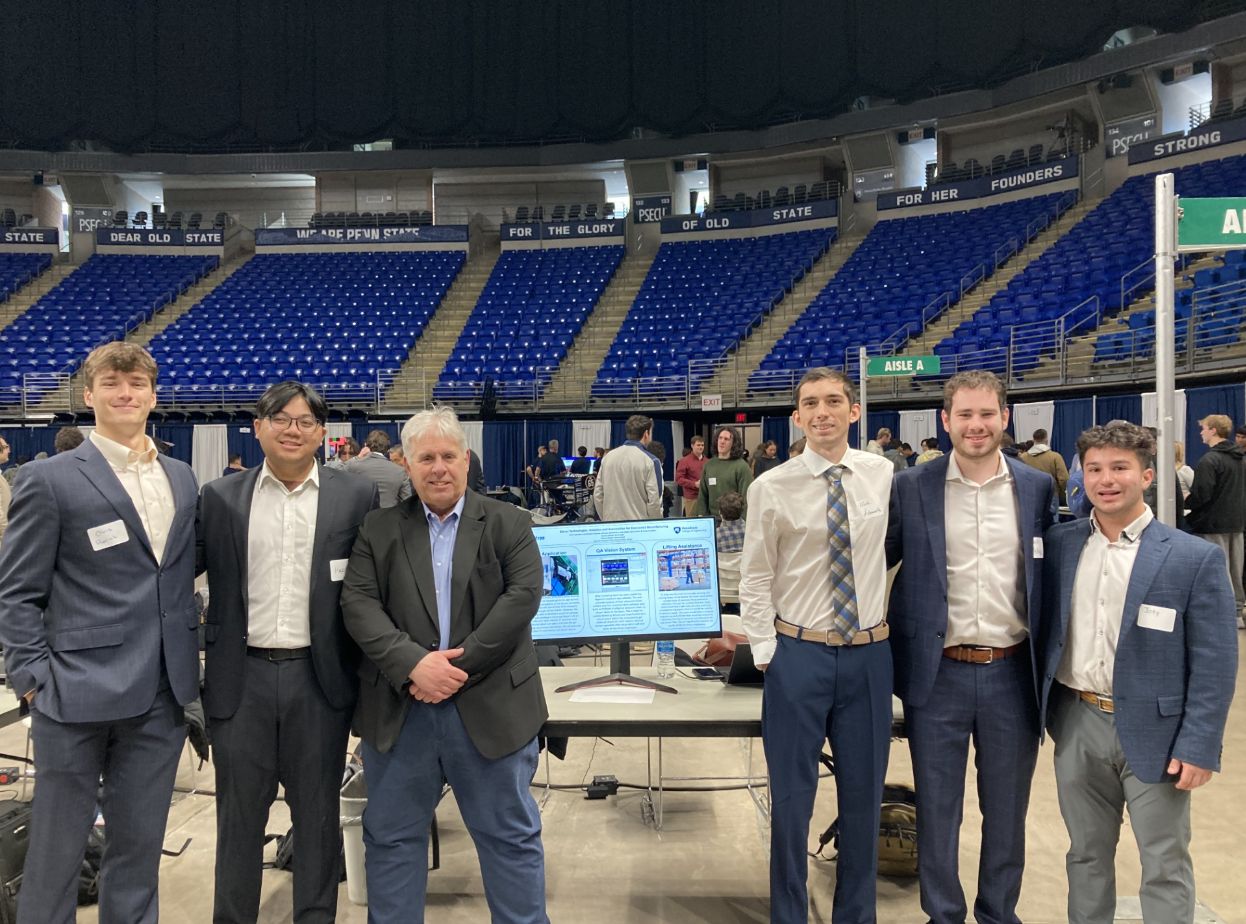
Kitron’s 2025 Learning Factory project connected their team to Brian Zajac, Professor of Practice & Director of Industry Relations in the College of Engineering, whose focus area is advanced manufacturing and robotics. He visited the facility, along with a team of students, to evaluate the production process.
“Kitron’s production was manual, specifically the assembly of a product for the electrification sector, and the company was interested in opportunities for automation to help reduce costs and improve quality and throughput to meet growing demand,” Zajac shared. “The focus for the project was to automate the dispensing of glue with a robotic arm.”
For proof of concept, the team tested the process using a robotic arm at OriginLabs, Penn State’s manufacturing makerspace, then conducted a live demo for a team from Kitron to complete their project.
The project and company’s interest in modernization prompted Zajac to engage Kitron with another program in the College of Engineering, Certified Microcredentials. Several Kitron team members completed Zajac’s three-course series in robotics for manufacturing. A continuing education grant covered fees for the courses.
“Kitron’s team was fully engaged in the robotics courses,” said Zajac. “Thanks, in part, to their enthusiasm, the cohort had a hands-on learning experience at the Penn State Digital Foundry at New Kensington to complement their coursework.” This opportunity was built out of a collaboration between the College of Engineering’s Microcredential Program and The Digital Foundry’s expertise in robotics training. The goal was to enhance the online experience with hands-on learning.
Garry Hinton is the engineering manager at Kitron whose team completed the program. “I believe it’s important to push your team to the next level, and I look for training that will grow individuals and our organization,” Hinton said. “We’re in the next evolution of manufacturing. It gives us a jumpstart on our competitors when we gain hands-on knowledge in automation and robotics and learn to implement and maintain those tools effectively and safely. This program checked all the boxes.”
Mr. Couch doesn’t expect Kitron’s most recent experience with Penn State to be their last. “We’re growing so quickly, I need to reconnect with Amy and tap into new opportunities with PennTAP,” he said. “We’re also looking to enroll another group for the robotics courses, and I’m hoping to merge some of the Learning Factory students’ work with efforts of our internal engineers.”
Kitron was unable to implement a robotic arm to automate its gluing process due to the weight of the parts and complexity of the assembly, but Mr. Couch still considers the experience a success. “From my perspective, the relationships you build are more valuable than the project itself,” he said.